
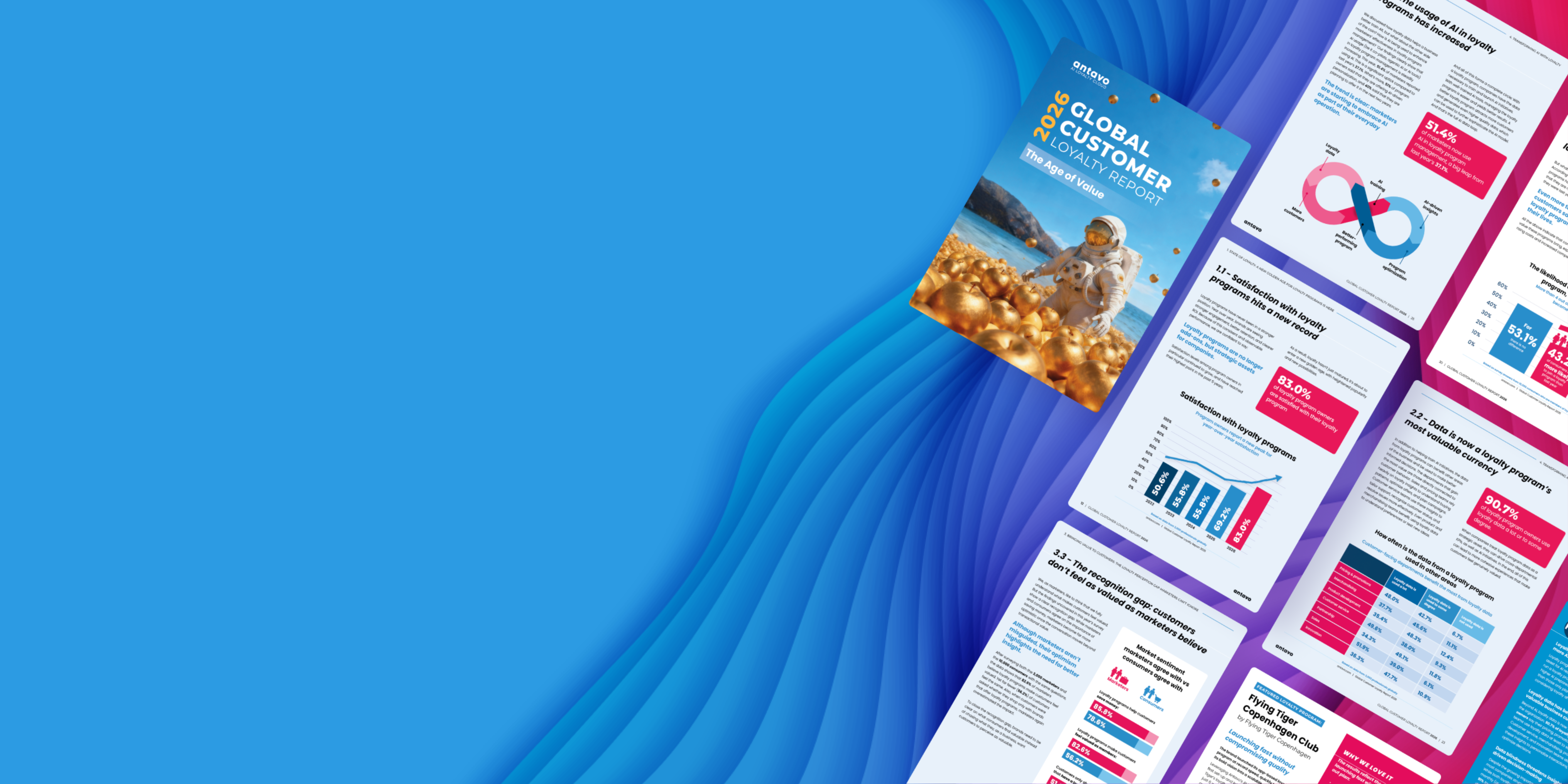
Global Customer Loyalty Report 2026
The loyalty program landscape is entering a new era, a true golden age. Driven by the rapid rise of artificial intelligence, evolving consumer expectations, and increasingly sophisticated relationship strategies, loyalty programs are becoming smarter, more personalized, and more strategic than ever before. The Global Customer Loyalty Report 2026 stands out as an essential guide to understanding and mastering this major transformation.
This new edition highlights key performance indicators that have improved, shifts in consumer sentiment compared to last year, and the gaps between marketer expectations and customer realities, a critical challenge for building strategies that are truly effective and aligned with the market.
This comprehensive report is based on:
More than 3,000 survey responses from CMOs and loyalty experts worldwide
The analysis of over 500 million loyalty actions, providing unparalleled insight into member behavior
Feedback from 10,000 consumers about their loyalty program experiences
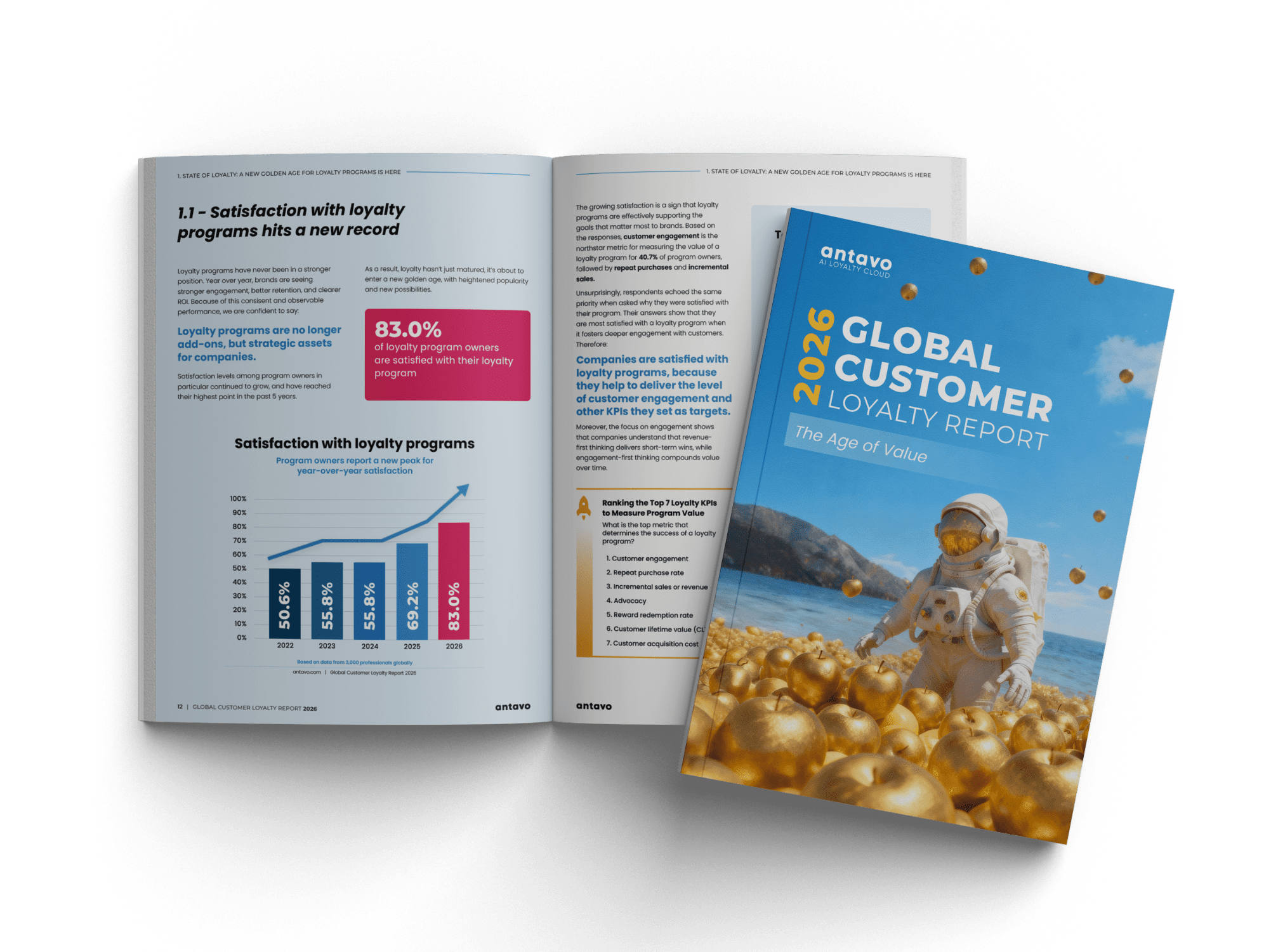
The golden age of loyalty starts now
Whether you’ve followed the evolution of this report since its early editions or are discovering it for the first time this year, this 5th edition provides the tools to invest with confidence, strengthen customer engagement, and position your loyalty program at the heart of sustainable growth.
Key highlights from the Global Customer Loyalty Report 2026:
• 89.4% of program owners are confident that loyalty drives value they wouldn’t otherwise achieve
• 43.2% of consumers are more likely to join a loyalty program than last year
• 9 out of 10 program owners report challenges in analyzing their loyalty data
Watch the full webinar
Loyalty reaches a new level of maturity
Loyalty programs are delivering their strongest results to date, both in satisfaction and ROI. They are now seen as strategic assets capable of driving engagement, purchase frequency, and incremental growth. Organizations are investing more in retention, confirming that loyalty has become a core pillar of business performance.
Loyalty programs power artificial intelligence
Loyalty plays a key role in preparing organizations for AI through the first-party and zero-party data it generates. Companies with loyalty programs are further along in their AI adoption. In return, AI enhances personalization, analytics, and program optimization, creating a continuous cycle between data, learning, and performance.
Data activation becomes the real challenge
Although teams aim to review performance regularly, most organizations struggle to understand and activate their loyalty data. Data quality, integration, and attribution issues limit the ability to connect loyalty initiatives to business outcomes. Moving into the era of value depends less on collecting data and more on turning it into actionable insights.
Strong customer interest, but value is poorly perceived
Consumers show growing interest in loyalty programs and increasingly integrate them into daily life. However, they express frustration when rewards are hard to earn, unattractive, or expire too quickly. Brands tend to overestimate how valued members feel, highlighting a significant gap between marketing perception and real customer experience.
Toward intelligent, adaptive loyalty
Static, rule-based programs are no longer sufficient in the face of changing customer behaviors. The next generation of loyalty relies on dynamic systems that can learn, adapt, and orchestrate relevant interactions in real time through AI. Loyalty is becoming a continuous experience platform at the core of the customer relationship.
Download the full report to explore these exceptional business opportunities.
Audio transcription
Hello, everyone.
Welcome to our Global Customer Liberty Report 2020, 2026 launch, a live stream. We’re pretty excited here. It’s a big thing.
We have a live audience and I also see that people are joining us as we speak, so no pressure everyone. It’s only 1200 people who signed up to this webinar. So yeah, it is a pretty big deal, but this is how it should be because this is our biggest event all year when we are launching our biggest annual research.
please, um, people who are joining online, if you could write where you are joining from. Write it down. There is this public chat on your right. Um, anything you add there is visible to everyone, but, um, your only your first name will be visible.
So, Um, today, what, we would like you to learn is basically 3 things. First is how to benchmark your loyalty program wherever you are in your geography, in your industry, or in your customer group. Number 2 is to learn about the latest trends. And then number 3 is that you can use this research in your presentations for your board or management or colleagues. So basically, whoever needs convincing, You can use this report for that to prove your point.
So welcome everyone. Let me see people who are joining us from all kinds of places. Oh my God, already like 90 comments about where you are from, like Audrey from Switzerland, Ornela from Italy, Luke from Sweden.
A stewart from Perth, Australia, Rich from Chicago, wow, Camille from Montreal, Francisca from Germany, Dusseldorf, thank you so much for being here. It’s like, it means so much to us. I’m like so happy to see, to see all this.
OK, so, um, I’mhujo Keshmar, um, chief strategy Officer and co-founder at Antabu AI Loete Cloud, and today I’m here with two brilliant experts, Michael Mitchell and Andreanne Rondeau. please introduce yourselves.
Sure, thank you for having, having me and having us here today. My name is Michael Mitchell. I’m the vice president of Global brand and Creative at Bloomreach, and this is extremely exciting.
And hi, Andreanne Rondeau, from stratLX, um, so loyalty specialist and founder of stratLX, um, I’m very, very excited to be here because it’s our 5th, edition of the report and live for the 1st time.
Yes, this is the first time when we are live and, just to tell you about our companies too, um.
We are, I’m from Antabo. We are the founders of Antabo, and the reason why we exist is because customer loyalty and loyalty programs need an operating system, and that is our technology, the An AI loyalty cloud. We help with technology for the entire loyalty program life cycle from planning to executing and optimizing your loyal. Loyalty program and that is all supported by our co-pilot Teamy AI and this is the team behind the technology.
This is taken last summer at the untable days when we just come together and be together and meet and you can see all the smartest engineers, AI researchers, product people, and loyalty experts. So this is us and a couple. Brands that we serve, um, like Skims, KFC, Hyatt, Flying Tiger, Jelly Cat, and there are many others. Bloomreach is one of our best technology partners, and then maybe Michael, you could share a couple of words about Bloomreach. Sure,
of course. Bloomreach is an AI technology platform that personalizes the entire customer experience.
We’re powered by our by our personalized AI called Lumi which we call the mind behind the best minds in marketing and it powers our entire suite of offerings from marketing automation, e-commerce search, conversational shopping, and agentic personalization.
That’s perfect. And just as Adrian mentioned, this is our 5th global customer loyalty report together with Adrian. And uh first we wanted to have Adrian for her analytical thinking. Then we realized like what an amazing loyalty expert she is. And I guess now this is our thing, right? Like, this is our thing that we do this together. Can you please tell more about what you do when you are not launching the Global customer loyalty report with us,
so we’re a loyalty consulting agency based in Canada, so we do help brands in building, lasting and profitable relationship with their customers, um, so working from end to end, from the strategy into implementation and optimization, and these are some of the brands that we’ve, designed loyalty program, optimized or managed their loyalty program with.
Thank you. So, this is our agenda for today, for the next 150 minutes or so. Um, first, we will be talking about the eras of loyalty programs, and I have to tell we were inspired by Taylor Swift here, then about the state of loyalty today in 2026.
Then comes how AI transforms loyalty or question mark is this loyalty that transforms AI. And our fourth topic is the reception gap that marketers often experience when we talk about our customers or when we think about our customers. And there will be time to answer questions. We will have 15 minutes for that, and we will wrap up 5 minutes before the hour, so you will have time to catch up before your next meeting.
Feel free to ask your questions on the right in the chat. I don’t know where you see me. Maybe there on the right.
And um uh my colleagues will help uh us to sort them because we are expecting a lot of questions like how we usually receive and there is some encouragement too, um, and I will tell you more about that. But feel free to take screenshots of this presentation. So from now Now this is all public information. So if you want to take screenshots, pictures, use it in social media, share your opinion on the numbers that we are going to present, make sure to tag us, tag me, and I can add extra information, and we will comment all your posts, basically.
And speaking of activity in the chat, we’ve also got a surprise for you, a little draw. You can win one of the 3 printed copies of the space puppies, because last year we had 1 space puppy, and then look at, look at them now, like they, they evolved over time, like they grew and paired up. So now there are 2 space puppies and they are also part of the report, and actually we have this printed.
So look at this, you would like to win this amazing piece of art.
Then let me tell you what you need to do. Thank you. So basically, if you would like to win this, first of all, pay attention to this session. Second of all, be active in the two polls that are coming.
And third, when we do the Q&A part. So, it, it’s helpful if you like, ask your best questions. And, at the end of the webinar, we will draw 3 lucky winners. You can have this piece of art delivered to your door wherever you live in the world.
So this is our little sweetener for the deal.
So you know that this is not the first time we do this, and then when thinking about the report, we kind of like astronauts.
Um, it symbolizes the market here with like going through these uncharted territories, and now we are revealing the cover of the 26th global customer loyalty report. This is the part where you can do the drum roll. We don’t have the drum roll, no worries, but this is it. So this is the 2026 global customer loyalty report.
Um, there is an astronaut that feel like so much, and this time the astronaut is wading through this sea of golden apples, which are valuable golden apples, all of them promising a new opportunity, and it’s not a coincidence that the title of this year’s report is The Age of Value.
And how we created this report, well, first of all, we analyzed 500 million loyalty program member actions. It’s a lot of member actions, and these are from the loyalty programs that are running on Antable, and this is double the amount than last year.
We also did a survey with 3000 marketeers and 10,000 consumers globally. And look how it turned out, like, it is beautiful, right? We always talk about B2B which sometimes rhymes with business too boring, but it’s totally business too beautiful, isn’t it beautiful? And um we purposefully edited this in a way that you can spend either 5 minutes or 20 minutes or an hour depending on how much time you have.
And whichever you choose, we wanted just you to get the message. If you only have 5 minutes, this is the table of contents that you should go through because it will already tell you where the loyalty industry is heading, what are the biggest challenges, and what customers want.
We have all kinds of insights from easy to quote quotes to charts and explanations. You can screenshot. these and then you can use in your presentations. We also have calls from industry experts like, like Marius Demario from Data Labs, Miti Lopez Barinello from Digitas, and Andrew Doyle from EPA, and Adrian and Michael. And we also have anti product pages and case studies from great brands like Flying Tiger, Paul Smith, or Panera.
Um, so let’s dive in. Remember I told you that we were inspired by Taylor Swift and also our report turned 5 years old, so we wanted to reflect on the past, the present, and also the future of loyalty programs.
So imagine this timeline for loyalty programs, and the loyalty programs as we know them, they started with the airlines, hotels, and credit card companies.
This is the points age. You got rewarded purely based on spend, and the rewards were either upgrades or incentives for the next. Purchase. Then came the brand, and this is when companies realized that loyalty can’t be bought with coupons alone, and this is when the things like omnichannel or gamification or personalization or brand experience, all these terms were born. And this is also the time when we founded Antabo 10 years ago to answer these needs. So not only the huge companies could afford a loyalty program, but also mid-market and smaller enterprise companies could do that.
The 3rd age, the data age is just what we passed, and it’s all around, all around this post-COVID experience that we all know that the importance of really, really knowing your customer. And they’re all things happening at the same time, like changing cookie policies, and there is this new scrolling culture, all kinds of data regulations. And nowadays, 0 and first party data are the most precious values that a loyalty program can provide.
And in 2026, we are about to enter a new age, the value age, which is also the title of the report, and the concept of loyalty programs will evolve and customers are now shopping through AI chats, and marketers have AI tools like Antable. Loyalty programs are becoming. like a living, breathing thing that can change over time, designing, launching, managing, optimizing loyalty programs. This should be a breathing, living thing, and they are valuable both for the company and the consumer. This is why they call it the age of value.
So what is it we can expect from this value age?
First of all, vibe configuring loyalty programs.
And Adrian asked me yesterday, like, what is vibe configuring, and it’s a, it’s a term I made up after vibe coding that means that instead of spending weeks learning a, a tool, today, it’s easier to do with natural language.
It’s just very similar to vibe coding.
Second is real-time adaptive decision making when your tools are in the same system as where your information is. So you can inquire them as you go.
And number 3 is that loyalty is the brain of CX as customer experience. With all these things that I just talked about, your loyalty program can be this ever changing layer of customer experience. Unfortunately, Gartner agrees with us as they predict that the use of AI agents will shoot up this year.
So that’s great and let me pass the mic to Michael who will share his perspective on how do we get ready for this value age.
Yeah, thank you. I think there’s, there’s a great quote in, the report that says the.
The, the era, the 3rd era.
Was helping prepare the lake, the data lake for all of our brands and customers that we work with, and then era 4 that we’re in right now, the age of value, is really about teaching those brands how to swim inside that.
Lack of data and I really think AI is that swim instructor and that opportunity to really help all of our brands become Olympic level swimmers um in this age of value and at Bloomreach we’re attempting to provide that swim instruction through our proprietary AI Lumi um which can take that first party data that context from your business, your customers, their past.
behavior and their future intent, um, analyze that in real time, lay on top of it AI models, that are proprietary to us. We also partner with Nvidia and Google and the best in, in, in, in class to then orchestrate that across all of the surfaces that your, customers may interact with, including the most latest ones like LLMs, um, and we continue to optimize and learn from each interaction and each behavior.
To again to continue the metaphor, be that swim instructor to help brands learn how to navigate those data lakes that they’ve built before.
That’s perfect. Thank you, Michael. And this brings us to our next topic, and that we would like to start with a poll. Um, remember, if you wanted to win the Space puppy prince, cast your votes now.
this question is from the report itself actually, and, let’s see whether your thinking aligns with the global answer.
So the question is how much of marketing budgets are spent on loyalty and CRM. Is this below 30%, um, between 30% and 60%, or over 60%? So cast your votes and I can see the numbers here.
Most people right now think that it’s below 30%.
Like the second option is growing a bit too, but it seems that people think that it’s below 30% that is spent on loyalty and CRM that is basically the existing customer.
And uh I think, Barbara, you closed the poll, right? So we have the final answers and um According to our report, um, actually loyalty program owners spend 51% of their marketing budget on the existing customer, that is loyalty and CRM, like customer retention overall, like the likes of Bloomridge and Antavo, and so on. And your guess was a little lower than that. And for those who are planning to launch a loyalty program, this is 42%.
So first of all, this is a very nice and large number, and then we double checked this with multiple services companies. We reached out to each other and then we even asked Forester and Even, semi-competitors too, like, what do you think about this? And then all these people confirmed that, yeah, this is like a new reality because the existing customer is the new like gold that people want to harvest.
And um this is also a sign of maturity. Since COVID, um. The existing customers become very valuable, and spending on new customers with the amount of money that Meta and Google requires is very difficult.
So companies look at what they have already and they invest into their existing customers, oftentimes using existing customers as a growth engine. And this brings us to our second point underpinning that there is this new golden age for loyalty here.
We asked our 3000 people global marketer panel about their satisfaction with their loyalty programs, and we learned that 83% of loyalty program owners are satisfied with their loyalty program. This is a new record high, and then we also asked like, why are you this happy?
And the number one reason was that loyalty programs help foster deeper engagement. And why engagement is important because that is outside of the day to day business relationship that businesses usually have with their customers, but it still drives business. So this is the CX layer that we talked about before.
They also have data on loyalty technology. We as marketeers, what is that they value in a loyalty program technology.
And first of all, they want loyalty uh platforms to be easy to manage, and this is true both for program owners and those who want to launch.
Again, a sign of change in attitude because they know loyalty programs shouldn’t be this statute and forget it, but the constantly changing, living, breathing thing, and this is what we also think when the Develop our own product, that this should be easy to use, so we give you basically the AI agent to design a loyalty program, we give you the data analyst, the AI data analyst you always wanted to have but never had the budget to hire.
OK, so this was about the value of loyalty program technology, but what is the value of your loyalty program overall? And, um, Adrian, you are the expert on measurement, so please, um, share, share your thoughts.
Yeah, so when we look into the performance of loyalty program, like we typically start looking into the performance metrics. So we’re looking at incrementality, so, a larger basket size, increased frequency, um, all of that to get the incremental revenue and incrementals so that we actually end up understanding what the ROI is.
Um, and those metrics are really key and important, but they only tell half of the story.
And then if we look, if you screen, this the next one, that what’s interesting looking at this is that, from the report, we found out that 89.4% of the respondents were actually confident that loyalty was driving value they wouldn’t get otherwise. So this is the actual, the financial value, so it This is what loyalty generates, so the incrementality.
What is key as well and that um is very often overlooked is when we looked into what it saves, so we are talking about efficiency metrics.
Um, so, loyalty, yes, drives additional, um, incrementality and additional, revenue, but also um allowed to save, and be more efficient and Generally, um, so what I mean by that is a loyalty program, well well designed and well-executed, will actually reduce churn. Um, it could also reduce the dependency on, mass promotion. It could reduce, the volatility of pricing, when the competition increase or flatten the demand depending on the high peak season and so on.
Um, so if we’re not looking at these costs, cost saving and efficiency, we’re, we’re sort of missing half of the story and don’t get the true value of a loyalty program.
Um, so, so I think it is, very important to look into these, um, so that, that we get the full, um, understanding, and the loyalty is not so much like loyalty program, in this case, when we get the full understanding of that, it’s not so much, um, like we’re not debating that are we keeping the program or not, but it’s really like a tool to um have more efficiency internally.
That’s perfect, Adrian. Thank you so much. And uh this brings us to our second poll. Um, and again, we had a similar question in the survey, and here comes the question, how would you rate your company’s or team’s AI readiness? And here are a couple of options you can choose from. Like, we don’t feel ready, really, because like you would need the data, the analytics tools, the expertise.
Or you feel slightly ready because you have the data, but not so much and you have the plans to implement tools and agents, or number 3 is that you are confident, that you are ready, you have all the data, you have the processes, and you are confident about the tools and the people’s expertise. So, cast your votes, please, and then when we are done.
I will ask Barbara to display the results, and the results are displayed now, so most people feel they are slightly ready. So this is like the kind of middle answer and this is, I think that would be expected because most companies feel slightly ready. So when we produced this report.
We asked this question both from loyalty program owners and also those who don’t offer a loyalty program, and then you will see some more sophistication in the report because this group is also two groups, those who plan to launch a loyalty program and those who don’t.
And marketers could rate their AI readiness on a scale of 1 to 10.
And for those with a loyalty program, this readiness is 6.33.
And for those without a loyalty program, it’s 9 4.99. And so it’s, it’s clear that companies with loyalty programs are more AI ready. This is not a correlation but more like a fact that we observed.
And uh the other day, I was chatting with Phil Shelper who wrote the textbook on loyalty, loyalty programs to complete guide, and then he said that loyalty programs are the best source of consented zero-party data that can be fed to AI.
And if you see this in the context of these numbers, this actually proves exactly that.
So we arrived to the 3rd, um, and my favorite part of the report, when, which is around AI last year, we talked about AI transforming loyalty, but as you can see now, we talk about loyalty data transforming AI.
And um, so how this transformation works. And this is the AI data loop where we try to visualize this, and I will guide you through what this is.
So you start from the top left corner, the loyalty data, and if you have the data about your customers, you can better train the AI that you use.
And with the AI you can get a better performing loyalty program.
Because you have all the insights and opportunity to optimize, and all of this leads to more customers and more data, and basically the loop starts over. This is the AI data loop.
However, not everything is rainbow and sunshine. Only 9% of marketers says that they have no challenges when analyzing the data, meaning that the other big portion is not entirely happy and has problems, and this is data blindness when you don’t know what your data will tell.
And teams generally need the data. 1 out of 3 leadership teams expect weekly reports.
And the larger chart that you can see over there is about how other departments are using loyalty program data like pricing and promotions.
So, the conclusion is that you really need to be good at this, data analysis, and um this actually has driven our own product development um in the past year, so, so we could make it possible for you.
And then with AI came a new word and consumers now shop differently to how they shopped a year ago. I can see it on myself too when I’m comparing things or doing the research to buy this new uh washing machine.
And uh please tell us more, Michael, what is your take? Like, what is the future and present of um AI in marketing and retail?
Yeah, there’s a new channel out there which is all of these uh LLMs whether it’s Gemini or Chat GPT new places where people are beginning their research journey, their shopping journey, and opportunities for brands to show up there in meaningful and valuable ways, um, so to.
Prepare their own data infrastructure so that they have good communication with these new uh surfaces that people are on. So how, how do you connect.
Um, an agentic e-commerce experience from your website to chat GBT using things like MCPs, which are sort of the API of the AI era, Bloomreach, we are, we exist across all of these surfaces already, but we are currently launching, um, a new offering to connect people’s, our brand’s data to.
Those new channels like Chat GPT so that when they pull um that information it’s it’s not just the catalog that you have of your existing offerings but it’s the customer data, their behavioral data, it’s all of the personalization that you had before can then surface across these other channels so that you’re really offering a brand experience and not just a product catalog.
Um, thank you, Michael, and with this, we arrived to the 4th, 4th and last topic today, and this is about what customers think and how sometimes it’s different to market to how marketeers think.
And before we talk about this gap, um, there is a very positive thing going on and that is helpful for everyone here on this call or sitting here live.
And that is that consumers actually really like loyalty programs. It’s a great thing. 65% say that using loyalty programs are now part of their lives, and 43% says that now they are more likely to join a loyalty program than last year.
All this popularity, it’s really, really nice.
These are encouraging, so we are very happy about that. And um if you could tell more, Adrian, about how this looks like customers feeling valued because that is key and uh there are a couple of things that we learned from the
report. Yeah, definitely, um, a lot of things that we learned.
Um, so, so first, I’m gonna walk you through the, on the right.
on the right there, we actually asked uh consumer about why they would be disappointed in loyalty program, cause if we wanna close the gap, if we wanna make customers feel valued, we need to understand and see what disappoint them. And then we’re looking into, um, top one being that it actually takes too long to, earn rewards and then rewards that expire before you can use an an attractive reward. So we look a lot about, um, what friction can be in terms of, of reward choice and reward expiration.
And the outcome of this is actually what we’re seeing when we um analyze all of the 500 million in loyalty points or loyalty data points, is that there’s like over um 27% of customers that actually uh leave their point on spend, so they never redeem their points and then 10, 12% of these points expire. So, this is very unfortunate because um when customers are redeeming points, we’re seeing a much greater engagement into the, the, the program.
And then moving forward, um, to the next slide, yes.
so moving forward as well is, we ask, and that’s what’s very interesting because we, um, we now want to talk about like the gap, so we ask both marketers and, consumers the same set of questions to capture like their vision and their, feeling and perception. About loyalty programs.
And uh you stand right here, there’s some differences, but the main gap is actually on the second one, where we see that loyalty program uh make customer uh feel valued as members. And there’s 82% of marketers that think that their loyalty program makes customers feel valued, but there’s Only 56% of customers that agree with that.
So, we see this gap as being like a huge gap and we really need to close this gap.
Um, and I, I think it’s really, really important that we address that to be uh able to actually have a program that um bring uh like great performance for the business.
Um, so, the first thing we need to consider is, um, loyalty, in general is much more trust-based than it is transactional. We typically, you know, you were talking about the era of loyalty before, it was really like points-based, transactional-based, and we talk a lot about emotional loyalty, but I’m even gonna talk about trust-based loyalty, because to really feel uh valued and really feel loyal to a brand, you do need to feel the trust for that brand.
Um, so, that changed the whole way of how customers are evaluating brands and, and, and, and the loyalty program.
and not only they evaluate differently, but they evaluate like continuously. So, it’s not um a one-time shot, so I’m not just evaluating the loyalty experience or the brand experience I have when I redeem my points. I’m doing it through every touchpoint, every interaction, so whatever, like the communication cadences, um, how, the reward is simple to redeem any friction points. I’m going into, if I’m, um, even like at the service level, the resolution time when I’m, contacting customer service or chatting online.
even silence from brand are evaluated and contribute to trust.
Um, so this is very, very key, um, because if we take all of that into consideration, then, um, this is where we actually start like executing and Making sure that the loyalty strategy is within the operation of the business.
Because how we will execute and operate the loyalty strategy, it will actually destroy or create the value um and, and all the perceived value from customers.
Um, so, all that to say that if we, if we’re looking into this, um, loyalty, is way beyond like a strategy and a marketing responsibility or, I mean, value is way beyond the, a strategy or, um, a loyalty program or a marketing responsibility. It’s, it’s, it’s a company-wide responsibility and It’s really like a capability that across the organization, we need to be able to build, and this is how I think we’re gonna close this gap by addressing all of the insights and prior using these insights in all the different departments and services um to, to better serve the customer and then they’ll feel more value.
It’s great that you say that because one of the things that you mentioned before was related to how important it is that customers actually spend their points, um, because unspent points mean that they earned the points but they didn’t spend it and there is someone is feeling very disappointed about that. And just before we started this live streaming, I received word that all the information and press releases we sent out, they are starting to get published, and one of the mediums translated it into actual money. UK shoppers missed out on $3 billion in loyalty savings.
Yeah, and it’s true for all programs, like there’s a huge amount of points not being redeemed and it’s, it sits there, savings for customer and a huge opportunity for business. So we need to increase engagement and points redemption in program.
Um, thank you, Adrian. And of course, this is just like a small fraction of the insights that we have in our report. This is, I don’t even know exactly how many pages, 65, 68, but this year, it’s not 2 but 4 pages of all kinds of. Breakdowns, breakdowns based on country, industry, customer age, buying personas, and they are at the end of the report, so make sure to check them out because this will be the, the place where you find your number to prove your points if you are doing your big presentations or looking for benchmarks. And uh with this, basically the report is out.
Um, you can access the report by clicking the button on the screen if you watch this in the streaming platform, or you can find the download link in the chat. My colleagues are inserting the download link in the chat, and well done. You just attended the crash course on the latest loyalty trends in 2026, so congratulations for that.
Please do share your learnings and opinions on social media. Feel free. Make sure to tag us. And now I’m opening the floor to the questions. And um yes, this is our dedicated time to questions. And let me see, this is where we go into the chat and then see all those questions that have popped up. Oh my God, now I will need to find my way here. Like give me a second.
Um, All of your questions will be answered either here or outside of the webinar later in email.
So, let’s start with the first one.
Let me see.
um, so someone is asking, are these, are these numbers specific to a particular country or industry?
And uh basically.
The numbers that you saw today, right now, these are all global averages because we wanted to give you this general overview, but we have 15 industry sectors that we analyzed from airlines to fashion and then retail and then sports, so there, there are all kinds of industries, and we also have 13 countries from all over the world where we have these bigger samples.
So at the end of the report, you can find these 4 big data tables to find your, um, to find your answers.
- So question number 2, if compared with, other tools, how is Antabo OS different?
OK, yeah, this is definitely a question for me. So if you would compare Antabo with another solution, in one word, I would say that the cost of ownership for loyalty technology is the lowest in Antable’s case.
And the reason is because we take the whole loyalty program creation, management, and optimization journey, and we use AI to To save work for you. So basically there is this AI loyalty program designer, what we call the planner. There is this AI loyalty program data analyst that we call the optimizer, and overall, the cost of ownership this way is lower and very smart of the Antabo OS that you ask the OS because we call it the Antabo operating system.
All right. I think the next question is for you, Michael.
And I’m reading this question, be prepared. I thought Bloomridge does marketing automation.
But, um, how do you make it happen that your products appear in Cha GPT?
Yeah, Bloomreach, um, is a personalization platform across any channel that customers show up in so marketing automation is one way that we accomplish that, but our, um, data engine, Lumi AI allows us to personalize across every surface and of course as we continue to stay.
One step um ahead or alongside the technology advancements we’ve created, new opportunities for that data to get surfaced across places like Chat GPT and and LLMs so we’re continuing to innovate as quickly as the market is yeah.
That’s perfect. Thank you. Then the next question, I think it’s for you, Adrian, and it will be about ROI.
Um, are there any facts about ROI just like last year?
In the report, definitely there is. so we tracked the year over year, ROI results, and, it’s great to see that they’re improving year over year as well. So, this year, we found out that there’s 9, yeah, 9 out of 10 companies that are, measuring their ROI that actually have a positive ROI and the averages of 5.3x. So, for every dollar that is being Um, spent on loyalty, there’s a 5, 5.3x, um, revenue incremental.
Um, so it is a, it is a good benchmark for a company to use cause as, at stratLX we get that question a lot, like what loyalty generate and what can we expect in terms of ROI and I see some heads, and yes, we do get, questions like that.
So, um, so yeah, so helping brands to actually measure their ROI, this is great, benchmark, and there’s a, a great, um, regional benchmark as well in the report.
Thank you. question number 5. It’s, I think again for you, we don’t have a number related to this in the report.
so speaking on audience, how we value our customers’ feedback on products and services, is there a number, a percentage that make their satisfaction reliable? What do you think, Adrian?
So there’s no, no, we don’t have exact value on this, and I think it’s really a matter of like comparing as well, um, evolution over time.
So you need to. Have your initial, initial number, where do you sit at this moment, and then based on that, looking into your data to set that number and then based on that, make sure that you actually um target for higher and then work on um on some strategy to increase this number. So not so much of a benchmark but looking of where you start and where you move forward with that.
Yeah, and, and I think it connects back to your point before around building trust with the audience and with your customers and if you continue down that value-based strategy, those numbers should increase. Yeah, definitely,
yeah.
- Next one.
do we know why do customers in the Middle East feel the most valued? Great point. Someone already downloading the report and then checking out all the numbers. Well done, please do that, everyone. Download the report.
And ask away, we may be able to answer that, so, um.
Related to this, um, I remember the exact numbers and the region and also how we, um, how we saw that, um.
In the Middle East, loyalty programs are the most experience focused.
And I think this should be the one which would play like a big role in why these uh customers would be more engaged. So there is a great quality of loyalty programs, just like how the service quality these days is very nice in the Middle East. There must be some correlation over there. I don’t know if you have other thoughts related to this.
Or if you agree with me that’s also fine.
type of agree with you. I cannot especially of the of this area on the market, but uh it does make sense.
OK, question number, I don’t even know which one, but maybe 7 or 8. So, are you noticing any potential friction in the future that could affect the currently positive perception of loyalty programs?
Adrian, what do you think? Are you noticing any potential friction in the future that could affect the currently positive perception of loyalty programs?
Well, there’s a lot of friction that could happen would definitely uh bring the value and then, um, relying on what you’re saying when we talk about like additional channels as well. So there’s a lot of brands, I think that have not, um, yet integrated the existing channel into like it’s not. Fully connected and then these, um these um this connection can actually create additional friction. So now we’re laying like technology is moving fast and AI is increasing and then the shopping behavior and the uh customer behavior is changing as well.
So these are all like Um, unfortunately I was gonna say opportunity that the risk of, additional friction that we need to address as well. So I’d say I don’t know if I have anything to add, but
yeah, I, I think there’s an outsized opportunity with AI, but there are watch outs as well. If, if everything becomes agents talking to agents or every, every piece of creative doesn’t have a human touch or human in the loop, you risk alienating, losing emotion, losing trust, and as a result, using, losing loyalty.
And here, I would like to remind you that some of the things that we learned in terms of what causes friction, and I’m trying to find that. In one second, I will, I think.
Yes, so what, what friction means for people? For 49% of people, it takes too long to earn rewards, and this is a friction of like no action because nothing happens because you are just stuck in a loyalty program and can’t move to the next reward. So this is what 49% of people think that it takes too long to earn rewards.
Um, another number here is that 41% thinks that um it’s disappointing that rewards expire before I can use them. I can totally relate to that.
My H&M points are gone now, unfortunately, but I still love H&M, so no worries, but the points are gone, unfortunately, and this is what 41% of people experience too. And 38.9 thinks that it’s very disappointing that rewards are unattractive. This is again a friction that you experience when you just don’t know how to use your points, and we just established it earlier how important it is that people actually use their points.
OK, so question, next question, and I think Michael is the best person to answer that, so pay attention.
We are hearing a lot about how AI can and will unlock loyalty, but what do we see as the biggest challenge the loyalty industry will face in this new AI age. So we are hearing a lot about how AI will unlock unlock loyalty.
But what are the biggest challenges that we think um the industry will face?
Yeah, I think AI is great for speed and efficiency, but as a brand and creative person I’m always focused on emotion, humanity, and building trust with customers, and we need to make sure that in the race towards optimization and efficiency and speed we don’t lose sight of what actually builds loyalty is building a relationship with another person or with your entire customer audience and that.
Takes a conversation that takes humanity that takes um creativity uh and building trust.
Um, next question is about, um, in-store experiences. Does Antabo provide not only digital but also on-site loyalty systems like scanning passes at the till?
And thank you so much for asking this because of course I always love to talk about Anavu capabilities, and yes, so it’s actually where we are very strong when there is this omni-channel experience that needs to be created, and there is one loyalty program that needs to be used through the online store, but also through the physical channels like a store.
And there are multiple ways to do that. Um, you either just pull up your, pullback pass, which is the native functionality in Google Wallet or Apple Wallet, and like that’s the same pass that you would use as a boarding card or that’s the same one that you We use when you are paying and that’s that. Or the other option is that there is a mobile app and then you identify yourself that way. So the point is that there is a unique identifier and then that can be identified in the store.
But if you think of all the things that are possible in a store, you really should take advantage of that. And one of our customers who launched recently is Paul Smith, British menswear luxury fashion.
And then they have multiple stores. They have 80 stores in 20 countries. And um they can also unlock a reward. No, you can unlock a reward if you scan one of the dominoes in one of their stores where there is this like tunnel with all domino, domino pieces, and one of the dominoes is a QR code. And if you find that, and if you scan that, you are unlocking a reward.
So this is like.
A next level in a physical experience.
and AI can’t build that domino experience in store, so yeah,
you need actual humans,
real people to do that.
OK.
I think we have like 4 more minutes for questions and then we are drawing the winner who wins the space puppy.
The questions are still pouring in, so this is one of the most fun parts of the whole webinar, um, mm mm mm.
So this one is related to rewards. Um, Adrian, I think this is for you. So in terms of faster rewards, do you have good examples of loyalty programs where consumers are rewarded more quickly, but ROI is still positive.
So faster rewards and yeah of course
faster rewards. Do you have good examples of loyalty programs? Yeah, yeah,
sorry,
yeah, I just wanted to give you a bit more time by reading this up again so you can understand that’s fine. So in terms of faster rewards, do you have good examples of loyalty programs where consumers are rewarded more quickly but otherwise still positive?
Yes, and I don’t think there’s a direct relationship between how fast. Customers are rewarded and the, the ROI, um, it’s, it’s really like the value of what they’re redeem it for.
So, obviously, if you just increase the generosity of your program, eventually the ROI may get hit, um, but you can actually make sure that you have fast reward mechanisms, so like low, um, like, um, um, high margin, low ticket, items for redemption, for example, or there’s other ways of bringing like partners.
ship into there and funding as well with partners and, and vendors and also there’s a lot of different um options and lots of different ways of looking into increasing ROI and still giving uh um a fast reward experience, a fast rewarding experience. I think it’s, it’s, it’s really related. We don’t, we don’t need to think that because you reward faster, that it means that the, the ratio, the generousy ratio is actually higher. It’s just what we select as being available quickly, quick, yeah.
Um, and what I can add to that is one of our customers is KFC in the UK, and their loyalty program is all centered around the love for chicken, and the whole idea is that you would open the app every day to play with the games, and then you would go into the restaurants and then you would claim one of the rewards. So it’s very, very high speed, and the rewards are usually slow value, but just like how the purchase franency is quite fast.
The, the reward frequency is quite high too, so there is some coration between the purchase frequency and kind of the reward frequency,
yeah, and that’s a good example, can you see because if if you look in general into all like um uh QSR and fast casual, it typically. is an area where the redemption process is really quick and, and rewards the coffee uh shop program or like QSR uh program, where the rewards come very, very fast because the frequency is high as well and the ticket items are quite low, so, yeah, there’s a good example.
OK, next question, and maybe this is the last one.
do you have any recommendations on how to increase reward redemption rates? Charlie asks. So do we have any recommendations on how to increase the reward redemption rates? And uh we even have some numbers related to this in the report. first of all, rewards need to be appealing.
And there are some great examples when rewards are used as part of a draw, like, um, sacrifice this amount of points, which is like quite a big sacrifice, like a big amount of points, but your points will be gone only when you win that. So it’s like a, an, a mix of a raffle and a proper reward. But I think what is the most important is constant communication.
And Michael, please tell a bit more about that. Like, it’s not only email that you can use for communication. There are all kinds of ways.
Yeah, I think, constant communication and just understanding, again, just personalizing that experience for the customer. So I think being able to tailor the rewards specifically to.
Their their interests, um, what you can anticipate for their interests in the future and then like, like you mentioned constant communication across the channels they participate in whether it’s SMS, email, um, or any, any other space that they might be playing in being able to build that relationship that feels personal and not a mass communication to the entire base.
And I think this is our last question, and it’s a happily discussed topic about points.
How important is the use of points in modern loyalty programs? Aren’t direct benefits and monetary incentives more up to date nowadays?
And there are varying opinions, and I’m curious about yours, Adrian, a lot, but I think that points are nice because they are recognizable. So if you see points, then you know this. It is a loyalty program for sure. It makes communication quite easy.
Yeah, points are well understand, from, from customers, like definitely like we all know about points and we all know how it works, so it’s very, very easy to understand where it get, it can get tricky. It’s on the conversion rate.
We need to be very cautious on this, like having the, you know, I’m gonna pick an example, but, 1,256. Points for a dollar is not good practice. You need to make it more transparent and easy to calculate, but points can be like there is no right or wrong way of using or not using points.
Like points is one of the currency that can be used in loyalty, well understood, like I said, from, from customers, so very good for that. But there’s like downside to it as well in terms of transparency and how we communicate that ratio to dollar and all that, but, but, yeah.
Um, thank you for that, and I think we have 50 more questions that we didn’t answer and we will answer in email. So thank you so much for the amazing questions. How is it for you? A very exhausting experience to answer questions on stage just like this.
Like we could go another 2 hours, another 2 hours,
then we can dive into this and answer these questions right away, I guess, um, so.
That’s that, actually. Thank you so much for these amazing questions, and it is finally time to announce the three winners of the Safe Space Puppy print, showing you again, like a version of this, not this one, but something that is printed closer to where you live. And, um, yeah, this is my time now. To look at the screen because, yes, this is Joffrey, Alicia, and Lars, the three winners of the Space Puppy sprints. Congratulations.
look out to your email in your inbox so we can actually make it happen to deliver it to your door. And, well, thank you everyone and please. Read the report and, like, knock yourself out with all the stats and use the charts in your presentations and let us know how it went and then let us know if we can help with technology or strategy because we would love to help you with that. Um, so thank you, Adrian, thank you, Michael, and thank you, everyone.
Bye, bye, everyone.

